

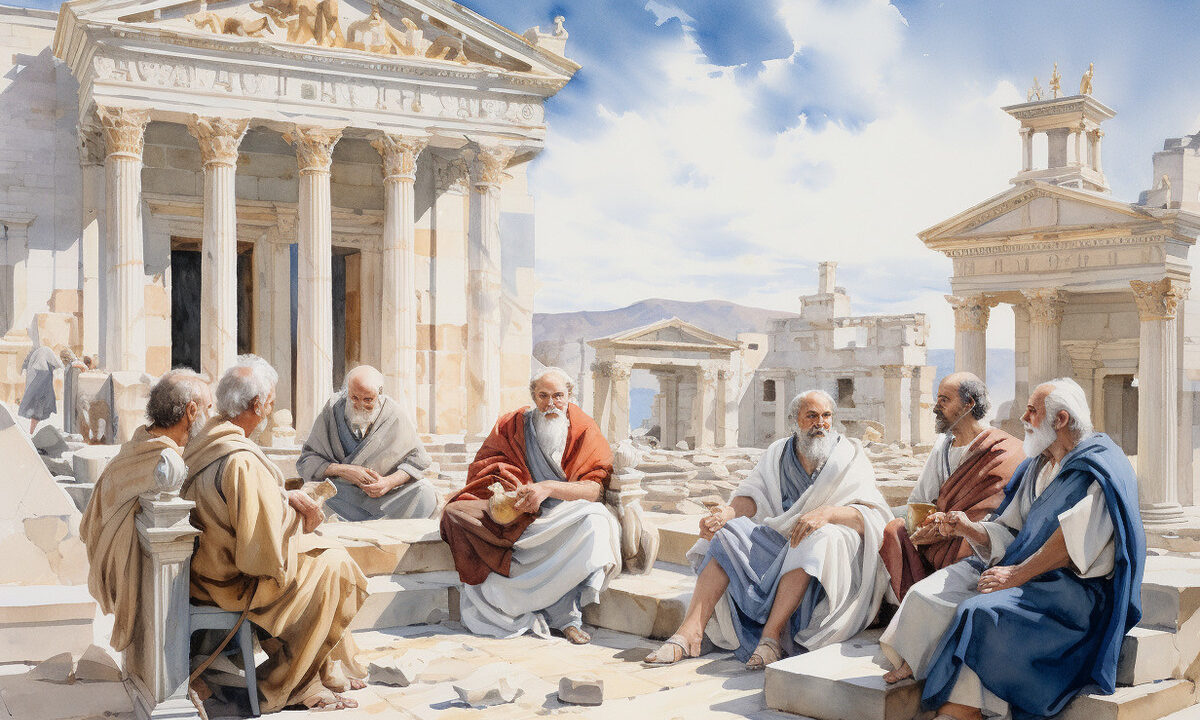
In the realm of philosophy, few eras have been as pivotal as the age of the Presocratic philosophers. These ancient Greek thinkers, living from the 6th to the 5th centuries BCE, laid the groundwork for Western philosophy, seeking to understand the natural world and the underlying principles that govern it. At the forefront of this intellectual revolution were figures like Thales of Miletus, Heraclitus, and Parmenides, each contributing unique perspectives that would influence generations to come.
Thales, often regarded as the first philosopher in Western history, proposed that water was the fundamental substance of the universe. This idea, though it may seem simplistic by today’s standards, marked a significant shift towards naturalistic explanations for the world’s phenomena, moving away from mythological interpretations. Heraclitus, known for his doctrine of flux, argued that change is the only constant, a concept encapsulated in his famous aphorism, “You cannot step into the same river twice.” On the other hand, Parmenides presented a radical metaphysical theory, claiming that reality is a single, unchanging, and eternal entity, with change and plurality being mere illusions.
The Presocratic era was also marked by the emergence of various schools of thought, including the Milesian School, the Pythagoreans, and the Eleatics. The Milesians, led by Thales, Anaximander, and Anaximenes, sought to explain the world through a single fundamental substance. The Pythagoreans, founded by Pythagoras, believed in the transmigration of souls and that reality is mathematical in nature, as famously illustrated by the Pythagorean theorem. The Eleatics, founded by Parmenides, challenged common-sense views of reality, arguing against the existence of change and plurality.
Despite the lack of direct access to the original works of these philosophers, due to the fragmented nature of the sources and the critiques from later philosophers like Aristotle and Plato, their ideas continue to exert a profound influence on Western philosophy. The challenge for scholars lies in reconstructing Presocratic philosophy through these secondary sources, considering the potential biases and limitations.
The significance of the Presocratic era lies in its role as the foundation of Western philosophy, marking a transition from mythological to rational explanations of the world. Figures like Democritus, with his atomic theory, and Empedocles, with his concept of the four elements, further enriched the philosophical landscape. Their ideas, though sometimes abstract and theoretical, paved the way for later philosophical giants like Plato and Aristotle.
In conclusion, the Presocratic philosophers were trailblazers in the pursuit of knowledge, challenging traditional beliefs and laying the groundwork for Western philosophical thought. Their diverse ideas and contributions, from the concept of a fundamental substance to the nature of change and reality, continue to inspire philosophical inquiry and reflection. As we delve into the works and thoughts of these ancient thinkers, we are reminded of the power of human curiosity and the enduring relevance of philosophical questions about the nature of the universe and our place within it. Whether through the mathematical musings of Pythagoras, the cosmological theories of Anaximander, or the metaphysical debates of Parmenides, the Presocratics invite us to contemplate the deepest questions of existence, ensuring their legacy remains a vital part of our intellectual heritage.
https%3A%2F%2Fdaily-philosophy.com%2Fthe-presocratics-overview%2F







No Comments