

Zeno’s Paradoxes: Can Anything Really Move?
Ancient Greek philosopher Zeno of Elea challenged our understanding of motion with mind-bending paradoxes that continue to spark debate millennia later.
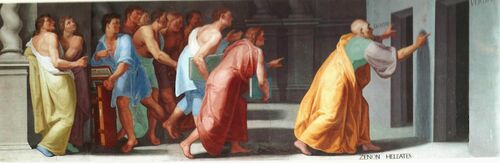
Zeno, a figure shrouded in mystery due to the lack of surviving writings (relying on accounts from rivals like Aristotle), proposed thought experiments designed to prove that movement is an illusion. His most famous, “the arrow,” suggests that a flying arrow is, at any given moment, stationary, leading to the seemingly inescapable conclusion that nothing can move. This isn’t a dismissal of reality, but a profound exploration of how we perceive time and space.
One of Zeno’s most intriguing paradoxes involves Achilles and a turtle. Despite Achilles’ legendary speed, Zeno argued he could never overtake the turtle, who is given a head start. As Achilles reaches the turtle’s initial position, the turtle has already moved forward, creating an endless cycle of pursuit. This seemingly absurd conclusion highlights the infinite divisibility of space and time.
Beyond his intellectual pursuits, Zeno demonstrated remarkable courage. Arrested for his involvement in a revolutionary uprising, he endured torture rather than betray his comrades, ultimately sacrificing his life in a defiant act of resistance against a tyrant. His final moments, biting the ear of his interrogator, exemplify a commitment to principle over self-preservation.
While initially perplexing, Zeno’s paradoxes aren’t necessarily flaws in logic. Modern understanding suggests that “movement” requires time – a change in position over time. Zeno’s work compels us to examine our assumptions about the nature of reality and the limitations of our perception. He invites us to question what we think we know, a timeless pursuit worthy of philosophical contemplation.
Do you find Zeno’s paradoxes interesting or boring? Tell me in the comments! Image source: Wikipedia.







No Comments