

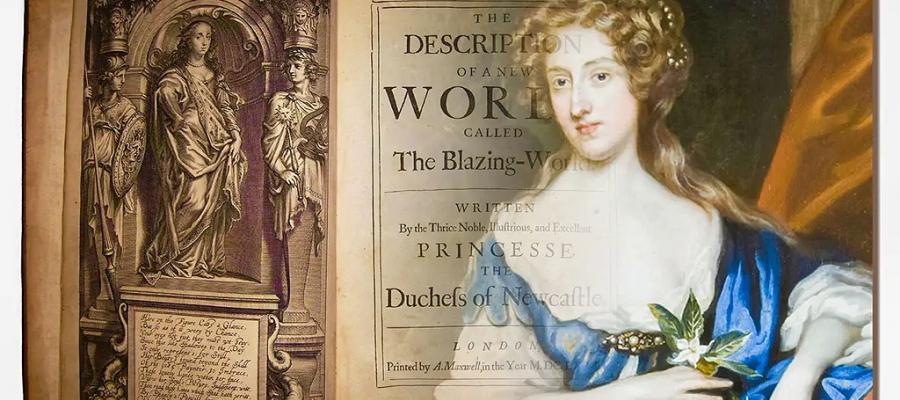
The Radical Idea of a Thinking Universe: Exploring Margaret Cavendish’s Vision
In the 17th century, Margaret Cavendish, the Duchess of Newcastle, emerged as a trailblazing polymath whose ideas were centuries ahead of her time. Among her many contributions to philosophy, science, and literature, one concept stands out as particularly audacious: her belief that everything in the universe thinks. Yes, you read that right—amoebas, rocks, trees, and even dust, according to Cavendish, are all engaged in some form of cogitation. While this idea might sound astonishing, even whimsical, to modern ears, it challenges us to rethink our assumptions about consciousness, intelligence, and the nature of existence itself.
Cavendish’s radical proposition was rooted in her rejection of the mechanistic view of the universe, which was gaining traction during the Scientific Revolution. While many of her contemporaries saw the natural world as a collection of inert objects governed by mechanical laws, Cavendish envisioned a universe alive with thought. She argued that matter itself was infused with a fundamental form of consciousness, a perspective that resonates with modern theories of panpsychism—the idea that all entities possess some degree of mental properties.
At its core, Cavendish’s vision was a deeply unifying one. She saw no sharp distinction between humans and the natural world, or between living and non-living matter. Instead, she imagined a continuum of thought that linked all things, from the tiniest particle to the most complex organism. This holistic view not only challenged the human-centric worldview of her time but also offered a profound meditation on interconnectedness. If everything thinks, then the universe is not a collection of separate, inert objects but a vibrant web of sentient beings, each contributing to the cosmic dialogue.
What makes Cavendish’s idea so compelling is its ability to inspire. By imagining a thinking universe, she invites us to cultivate a deeper reverence for the natural world and a sense of responsibility toward it. If rocks and trees think, how might that shift our relationship with the earth? How might it change the way we approach science, philosophy, and even daily life?
Margaret Cavendish’s radical vision of a thinking universe reminds us that the boundaries between mind and matter, thought and existence, are far more fluid than we often assume. Her ideas, though born in the 17th century, challenge us to think differently about the world—and our place within it. In an age grappling with climate change, artificial intelligence, and the ethics of consciousness, Cavendish’s philosophy offers a timeless wisdom: that the universe is far more alive, and far more interconnected, than we dare to imagine.






No Comments