

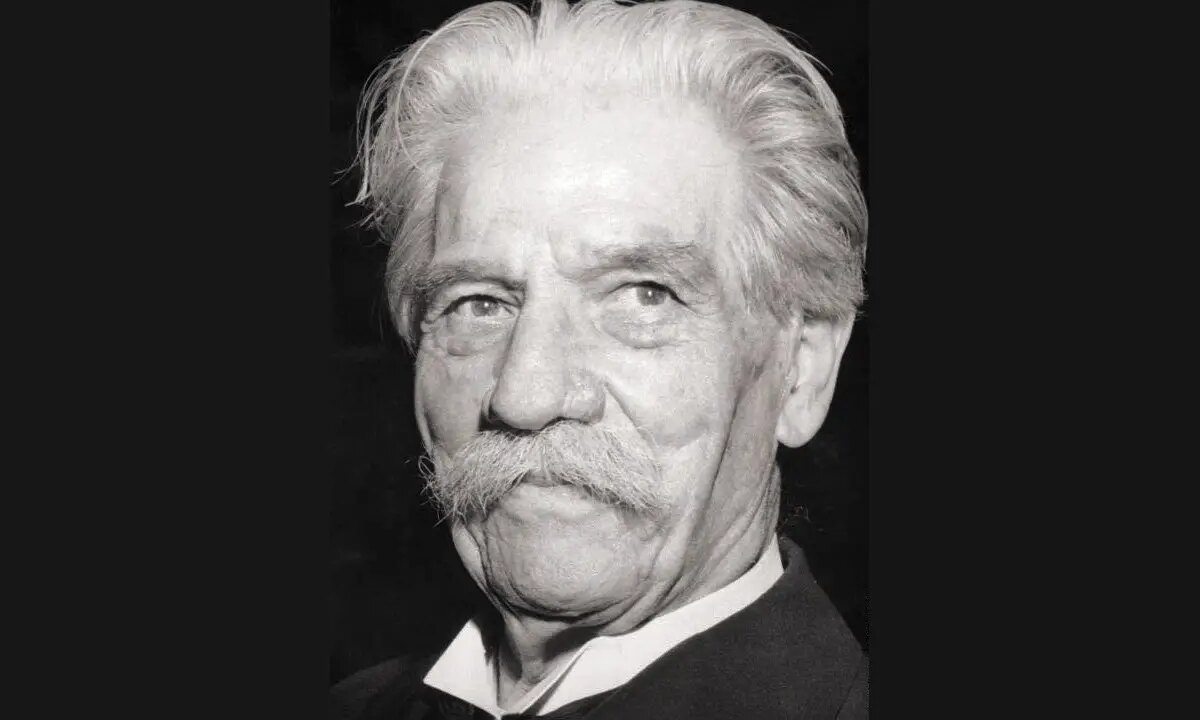
Ethics is Reverence for Life: The Wisdom of Albert Schweitzer
At the height of his fame, a renowned musician and theologian abandoned everything to heal the forgotten.
Albert Schweitzer (1875–1965) lived a life that defied convention. A contemporary of Einstein and Gandhi, he was an accomplished organist and respected theologian who eventually turned his back on the comforts of European academia. Driven by a crisis of conscience, he abandoned his privilege to build a hospital in the jungles of Lambaréné, Gabon. There, amidst the challenges of the African wilderness and the weight of colonial hubris, he formulated a philosophy so radical it remains a challenge to this day.
Schweitzer’s revelation struck him not in a library, but on a river barge surrounded by hippopotamuses. He had been wrestling with a universal definition of ethics, something more profound than academic theory. In a flash of insight at sunset, he found his answer: Reverence for Life (Ehrfurcht). He described this as a blend of honor and awe—a recognition that the divine manifests in every living thing. To Schweitzer, ethics wasn’t about abstract rules; it was the practical decision to maintain, assist, and enhance life.
This perspective united a profound sense of gratitude with a concrete moral imperative. Unlike his cousin Jean-Paul Sartre, whose existentialism often focused on the burden of existence, Schweitzer saw existence as a miracle to be affirmed. He famously stated, “I am life that wills to live in the midst of life that wills to live.” This realization dissolved the hard lines between species and hierarchies; if God is the orderly harmony of the world, then human life is not superior to animal or plant life, merely interdependent.
Ultimately, Schweitzer’s life was his philosophy. While academic institutions largely overlooked his work, he lived his ethics every day—carefully moving earthworms from his path and treating thousands of patients in his jungle hospital. He proved that true wisdom is not just what we think, but how we live. Schweitzer teaches us that the highest ethical standard is simply to look at the world, and every being within it, with reverence.







No Comments