

Rivian’s AI Assistant Is Coming To Every EV In 2026
Beyond voice commands, the rollout promises agentic third-party integration.
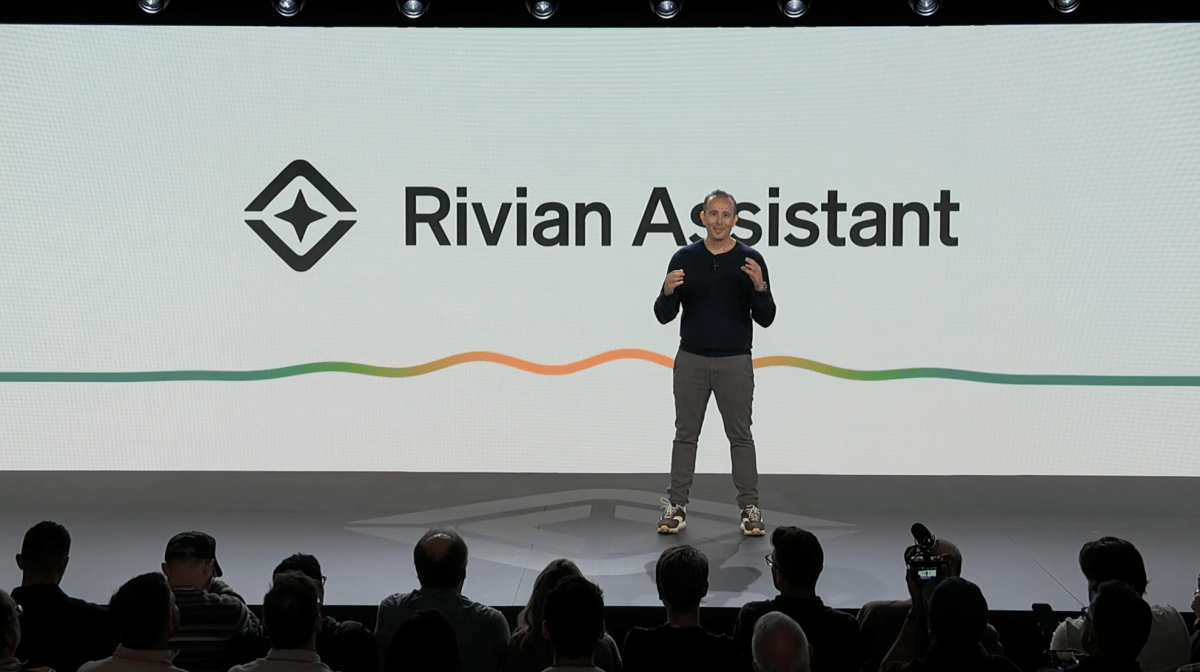
Rivian is officially putting AI at the center of its in-car experience. After two years of development, the automaker confirmed its proprietary AI assistant will launch in early 2026—and it won’t be exclusive to future models. Every existing Rivian EV in the current lineup will receive the upgrade, a move that signals the company’s aggressive push toward deep vertical integration.
The assistant’s core utility focuses on natural control over cabin functions like climate settings and infotainment menus. However, the real innovation lies in its “agentic” architecture. Rather than relying on rigid, closed-system commands, Rivian is building bridges to the open ecosystem. Google Calendar will be the first integrated third-party app, allowing users to manage schedules and vehicle planning within a unified interface.
According to Wassym Bensaid, Rivian’s software development chief, this approach fundamentally redefines how applications interact with vehicles. “The beauty here is we can integrate third-party agents,” Bensaid explained during the company’s AI & Autonomy event in Palo Alto. “This is completely redefining how apps in the future will integrate in our cars.”
This redefinition is powered by a sophisticated hybrid software stack branded as Rivian Unified Intelligence (RUI). While the assistant leverages frontier models like Google Vertex AI and Gemini for reasoning and natural conversation, the underlying RUI architecture is model-agnostic. It acts as a connective tissue, orchestrating a mix of Rivian’s custom LLMs and external AI models to ensure seamless operation. The goal is a system that can evolve without being tethered to a single provider.
But RUI extends far beyond voice assistance. Rivian is leveraging this intelligence layer to overhaul vehicle diagnostics. The system acts as a “expert assistant” for service technicians, scanning telemetry and vehicle history to pinpoint complex issues before they escalate. This dual-use strategy—serving both the driver and the service network—highlights CEO RJ Scaringe’s vision for total control over the vehicle’s lifecycle.
This software revolution is underpinned by significant hardware architecture changes. Rivian has spent the last year reworking the internal “guts” of the R1T and R1S, from battery packs and suspension to electrical architectures. To support the next generation of autonomy and AI, the company also announced a custom 5nm processor built with Arm and TSMC. This silicon will enable the expansion of Rivian’s hands-free driving system, eventually allowing drivers to take their eyes off the road.
By building its own processor and AI stack, Rivian is betting that proprietary tech is the only path to high-performance autonomy. The early 2026 rollout will test whether this massive investment in vertical integration can deliver a user experience that stands apart in an increasingly crowded EV market. For existing owners, however, the news offers a compelling promise: your vehicle will get smarter, more connected, and more capable without you having to buy a new one.






No Comments