

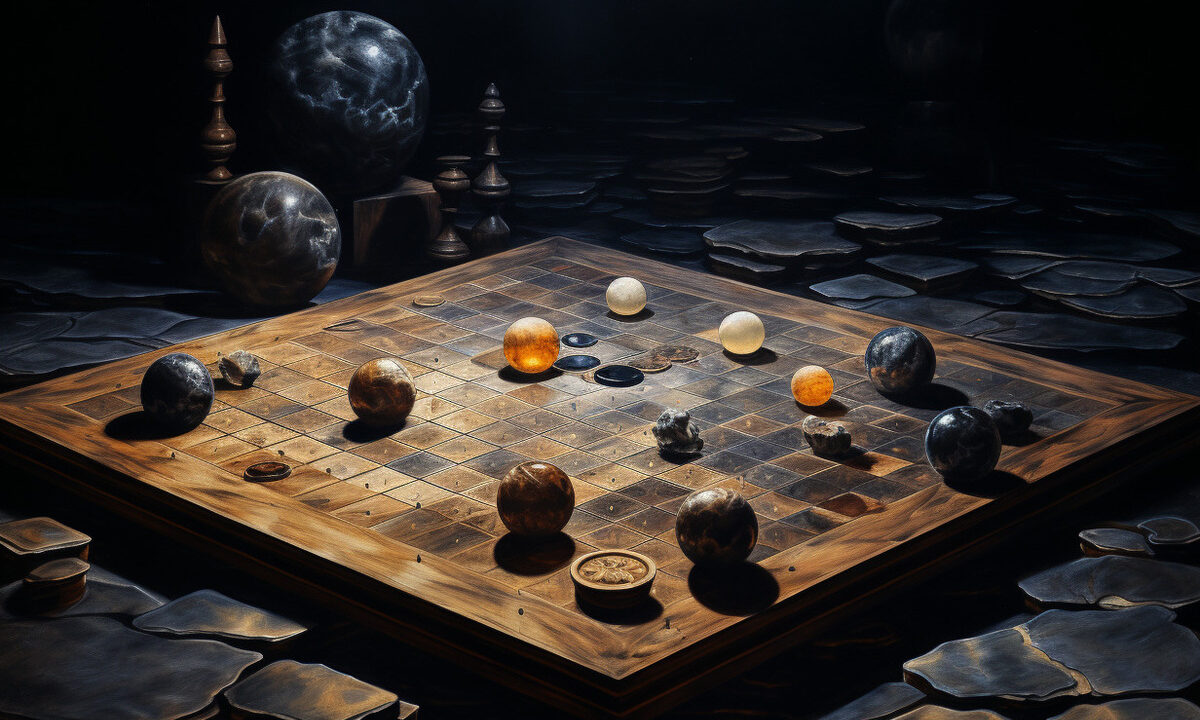
In the vast expanse of human imagination, few concepts have captured the essence of intellectual curiosity and the pursuit of unity as profoundly as Hermann Hesse’s “Glass Bead Game”. This visionary novel, penned in the 1940s, weaves a grand tapestry of ideas, merging the threads of philosophy, science, art, and spirituality into a majestic synthesis. At its core, the Glass Bead Game represents an abstract, symbolic system that seeks to harmonize the disparate elements of human knowledge and experience, reflecting the eternal quest for meaning and understanding that defines us.
The game itself, a product of Hesse’s boundless creativity, is described as a universal language, capable of expressing complex values and relationships through a combination of mathematical, musical, and philosophical principles. It embodies the dream of a unified theory, a calculus of the whole of reality, where the beauty of thought and art converges with the precision of science. This vision is not merely a poetic fantasy but a profound reflection of the human aspiration for wholeness and interconnectedness.
Hesse’s exploration of the Glass Bead Game also touches upon the role of contemplation and meditation in the pursuit of knowledge and wisdom. The game, as he envisions it, is not merely an intellectual exercise but a spiritual practice, requiring players to delve deeply into the meaning and significance of its symbols and themes. This emphasis on the inner dimension of knowledge and understanding resonates deeply with the traditions of mysticism and philosophical inquiry that have long sought to unveil the mysteries of existence.
The prophetic nature of Hesse’s vision is striking, given the subsequent developments in science and philosophy. The integration of disciplines such as biophysics, biochemistry, and information theory, along with the emergence of chaos theory and complexity science, all reflect the kind of holistic and interdisciplinary approach that the Glass Bead Game symbolizes. The work of scientists like Erwin Schrödinger, Norbert Wiener, and Ilya Prigogine, among others, has brought us closer to a unified understanding of the world, where the boundaries between physics, biology, and philosophy begin to blur.
In an age dominated by the rapid proliferation of information and the increasing specialization of knowledge, the Glass Bead Game stands as a powerful reminder of the importance of synthesis and integration. It challenges us to move beyond the fragmentation of disciplines and to seek a deeper, more unified understanding of the world and our place within it. As we navigate the complexities of the modern world, Hesse’s vision of the Glass Bead Game offers a compelling model for a more holistic and meaningful approach to knowledge and existence.
Ultimately, the Glass Bead Game is more than a literary device or a philosophical concept; it is an invitation to embark on a journey of discovery and exploration, to seek the hidden harmonies that underlie all of existence. In its depths, we find a reflection of our own quest for meaning, a quest that is at once deeply personal and universally human. As we ponder the mysteries of the Glass Bead Game, we are reminded of the profound wisdom that lies at the heart of Hesse’s vision: that the pursuit of knowledge and understanding is, at its core, a spiritual journey, one that leads us ever deeper into the mysteries of the universe and the depths of our own souls.
https%3A%2F%2Fdaily-philosophy.com%2Fhesse-glass-bead-game-4%2F







No Comments