

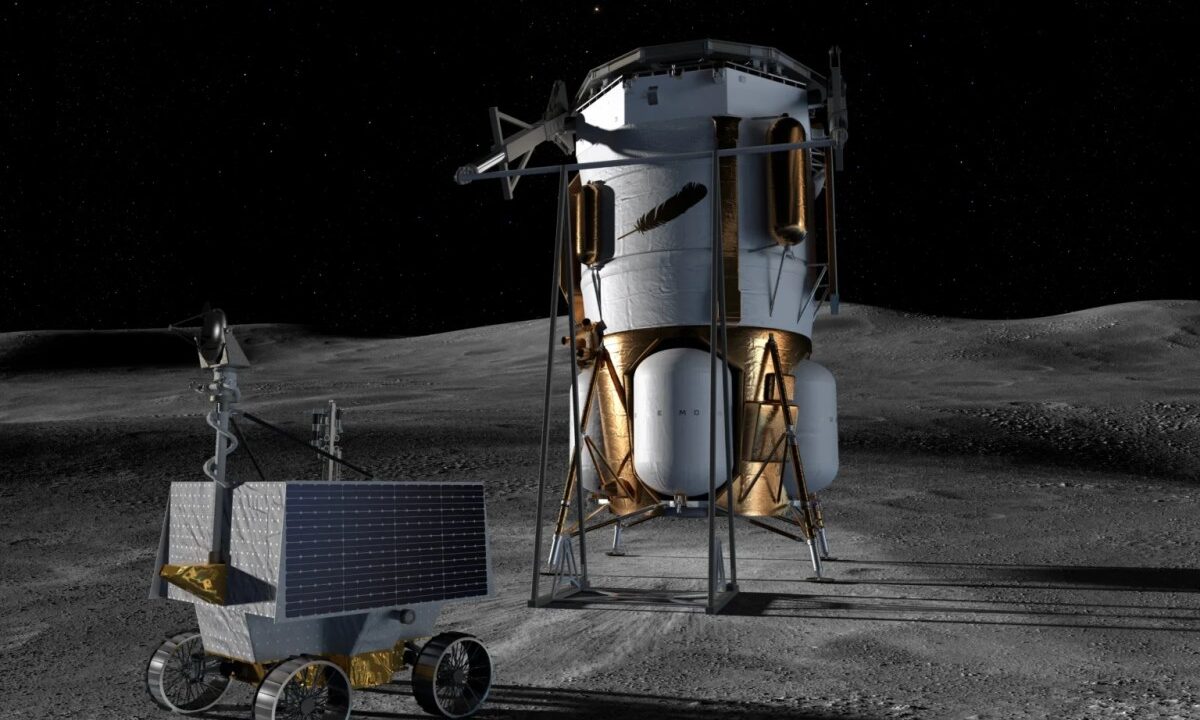
Blue Origin Secures Major NASA Contract to Deliver VIPER Rover to the Moon
In a significant move that underscores the growing role of private companies in space exploration, Blue Origin has been awarded a crucial NASA contract to transport the VIPER rover to the Moon. This decision highlights NASA’s confidence in Blue Origin’s capabilities and marks a new chapter in the ambitious plans to explore and utilize the lunar surface.
The VIPER rover, an acronym for “Volatiles Investigating Polar Exploration Rover,” is designed to explore the Moon’s south pole in search of water ice. The rover will be carried aboard Blue Origin’s Blue Moon MK1 lander, which is set to launch in late 2027. This mission is part of NASA’s Commercial Lunar Payload Services (CLPS) initiative, with the contract valued at approximately $190 million.
A New Lease on Life for the VIPER Rover
The VIPER rover’s journey to the Moon has been anything but smooth. Originally awarded to Pittsburgh-based Astrobotic in 2020 as part of a $199.5 million contract, the project faced significant delays and cost overruns. By July 2024, NASA was forced to cancel the program, despite the fact that much of the hardware was already constructed. The decision drew criticism from lawmakers and scientists, who argued that abandoning the project would waste valuable resources and momentum.
However, NASA quickly sought a solution. Just one month after canceling the original contract, the agency issued a request for ideas from U.S. companies to find a way to deploy the existing rover without incurring additional government costs. Blue Origin emerged as the ideal partner, offering a cost-effective and reliable solution through its Blue Moon lander.
The Science Behind the Mission
The VIPER rover is about the size of a golf cart and is equipped with state-of-the-art instruments, including a drill and three spectrometers. These tools will allow the rover to detect water, hydrogen, and other minerals in the lunar soil. Over the course of its 100-day mission, VIPER will map out the distribution of water ice in the Moon’s south pole, a region where scientists believe significant deposits of this vital resource may exist.
Water ice is more than just a scientific curiosity—it holds the key to sustaining long-term human presence on the Moon. By extracting water from the lunar regolith, future missions could produce oxygen for life support and drinking water, as well as hydrogen for rocket propellant. This capability would drastically reduce the need to transport these resources from Earth, making lunar exploration more sustainable and cost-effective.
Blue Origin’s Growing Role in Lunar Exploration
For Blue Origin, this contract represents a major milestone. It not only provides the Blue Moon lander with its first high-profile scientific payload but also solidifies the company’s position as a key player in NASA’s lunar ambitions. Earlier, Blue Origin had secured a separate contract under NASA’s Artemis program to develop a human-rated lander, further cementing its role in the agency’s plans to return humans to the Moon by the late 2020s.
This dual role—delivering both crewed and uncrewed payloads—underscores Blue Origin’s versatility and capability in advancing lunar exploration. The success of this mission will not only demonstrate the effectiveness of public-private partnerships in space exploration but also pave the way for more ambitious endeavors in the years to come.
The Bigger Picture
The VIPER mission is just one piece of a larger puzzle as NASA works toward establishing a sustainable human presence on the Moon. The Artemis program, aimed at returning humans to the lunar surface by 2025, relies heavily on the kinds of discoveries that VIPER will make. By identifying and mapping water ice deposits, the rover will provide critical data that will inform the design of future lunar habitats, life support systems, and resource utilization technologies.
Moreover, the success of this mission could have far-reaching implications for commercial space companies. Blue Origin’s ability to deliver VIPER to the Moon on schedule and within budget will serve as a proof of concept for the viability of private-sector lunar transportation services. This could encourage further investment and innovation in the space industry, driving down costs and opening up new opportunities for scientific and commercial activities on the Moon.
Conclusion
Blue Origin’s selection to deliver the VIPER rover to the Moon is more than just a contract award—it’s a vote of confidence in the company’s capabilities and a testament to the power of collaboration between government agencies and private enterprise. As the rover prepares to embark on its historic journey, it carries with it the hopes of scientists, engineers, and space enthusiasts around the world.
The discovery of water ice on the Moon could be the breakthrough that makes long-term lunar exploration a reality. With Blue Origin and NASA leading the charge, the future of space exploration looks brighter than ever. Whether you’re a scientist, an engineer, or simply someone who gazes up at the night sky with wonder, this mission reminds us that the next great chapter in human spaceflight is just on the horizon.






No Comments