

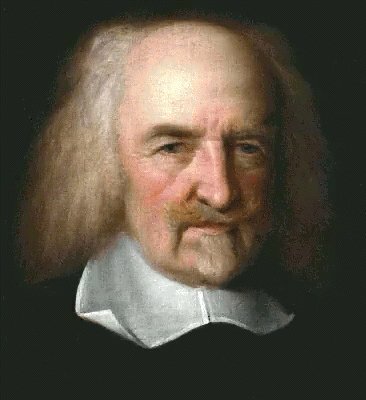
Thomas Hobbes: Social Contract, State of Nature, and Monarchy’s Case
Born 436 years ago this April, Thomas Hobbes reshaped political philosophy with a bracing, controversial vision of human nature and the only path to societal survival.
Hobbes (1588-1679) is the first of three canonical social contract theorists, preceding John Locke and Jean-Jacques Rousseau. He lived just a century after Europeans first reached the Americas, as intellectual life in Europe moved out of the Middle Ages. Rejecting religious belief as a basis for philosophical inquiry, he argued that morality and political systems should follow the same rational, observational principles that guided the emerging sciences, built on experiment and real-world evidence rather than dogma. He sought to create a rational morality rooted in observable human behavior, not scripture.
To test his framework, Hobbes posed the famous “state of nature” thought experiment: what would human life look like without laws, morality, or government, in a pre-historic setting where every person could act entirely on their own whims? His answer was unflinchingly bleak. Every individual would fight only for their own survival, spending all waking hours hunting, foraging, and defending meager possessions from others. There would be no cooperation, no time for education, no development of medicine or public infrastructure, no space for culture or advanced skill-building. His iconic summary of this existence: life would be “solitary, poor, nasty, brutish, and short.”
Unlike later social contract thinkers, Hobbes was no defender of democracy. He published early work warning explicitly of the dangers of democratic governance, a stance his social contract theory reinforces. Since all humans are roughly equal in physical power, he argued, the only way to escape the state of nature is to create a deliberate power imbalance: one group seizes enough authority to impose peace by force. For Hobbes, the social contract is not a mutual agreement between equal, self-interested citizens, but the coerced obedience of the weak to a dominant state. He held that monarchy, where a single ruler holds unchecked power and citizens have no right to oppose their decisions, is the best form of government to maintain that hard-won peace.
As we mark Hobbes’ 436th birthday, his ideas remain a foundational, if polarizing, pillar of political philosophy. Later thinkers would expand and challenge his anti-democratic conclusions, but his core question—what binds us to the systems that govern us?—still shapes how we talk about state power today.




No Comments