

Galileo’s Telescope: Seeing Isn’t Always Believing
The instrument that revolutionized our understanding of the cosmos also sparked a profound question about the nature of truth.
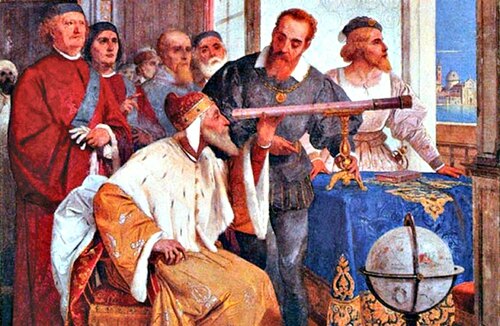
Today marks the anniversary of a pivotal moment in history: August 25, 1609, the day Galileo Galilei demonstrated his telescope to the Venetian Senate. This simple invention, born from an idea to observe the heavens, inadvertently became a powerful catalyst for both scientific advancement and societal unease. It wasn’t the telescope itself that was revolutionary, but Galileo’s bold application of it – turning this nascent technology towards the stars.
The Venetian nobles witnessed a breathtaking display: distant cities shrinking, ships appearing on the horizon hours before they were visible to the naked eye. While Galileo’s initial aim was astronomical, the senators immediately grasped the potent implications of this “magic metal tube.” They envisioned its potential for military advantage – spying on enemies, monitoring political rivals, and even clandestine surveillance. This highlights a fundamental question: the relationship between scientific discovery and societal application isn’t always aligned. Technology, often born from pure curiosity, can be readily adapted for purposes far removed from its original intent, and not always for the betterment of humanity.
Interestingly, Galileo’s pursuit of astronomical truth wasn’t initially driven by a societal demand for his invention. He wasn’t actively seeking funding or promoting widespread adoption. Instead, he focused on the celestial sphere, a pursuit that ultimately brought him into conflict with established religious and scientific doctrines. This raises another critical point: being “right” isn’t always straightforward. Galileo’s observations challenged the prevailing geocentric model of the universe, but his approach – lacking a robust theoretical framework and relying on observational evidence alone – wasn’t considered the most rigorous scientific method of his time.
Ultimately, Galileo’s legacy is complex. He is often celebrated as a champion of scientific progress, yet his story serves as a powerful reminder that scientific truth can be relative to the prevailing understanding of the time. He was arguably right in his observations, but his conclusions were built on a foundation of incomplete scientific principles. His dedication to unraveling the mysteries of the cosmos, even in the face of societal pressures and intellectual challenges, solidified his place in history.
Galileo’s telescope wasn’t just a tool for seeing farther; it was a tool that forced humanity to confront the nature of knowledge, power, and the often-unforeseen consequences of groundbreaking discoveries. It reminds us that the pursuit of truth can be a winding path, and being right doesn’t always equate to doing what is “right.”






No Comments