

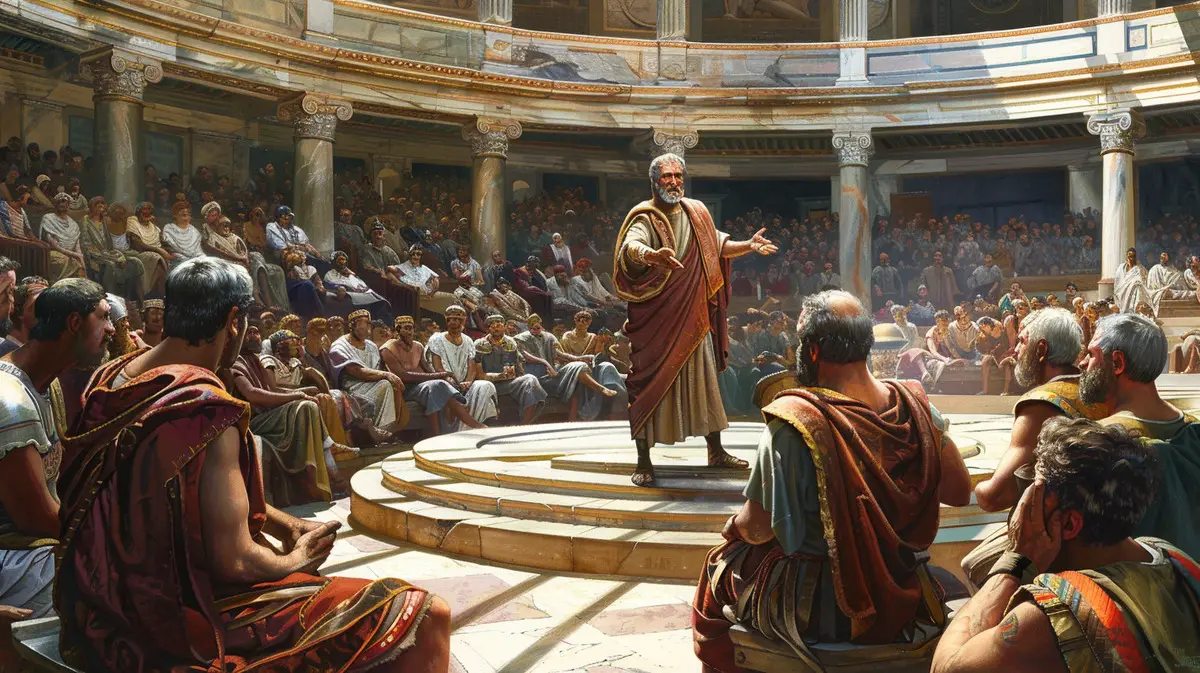
In a world where “things fall apart, the center cannot hold,” as William Butler Yeats so eloquently put it, the question of whether democracy can hold in tension “liberty and justice for all” is a pressing concern. This conundrum is one that has plagued philosophers and politicians for centuries, and Plato’s work provides valuable insight into the relationship between freedom, democracy, and justice. Plato’s Republic, often misunderstood as a treatise advocating for totalitarianism, is in fact a nuanced exploration of the tension between liberty and justice.
For Plato, the overriding principle to cultivate in society is not liberty, but justice. He argues that a perfectly just city would have a rational economic structure, where individuals are free to pursue their passions and contribute to the greater good. This idea is built on the analogy between how a city is organized and how a person’s character is organized, suggesting that just as a city functions best when everyone does the job they are best at and enjoys, an individual’s psyche functions best when each “part” is doing what it’s best suited for.
Plato’s critique of democracy is not a rejection of the concept altogether, but rather a warning about the dangers of unchecked liberty. He argues that when liberty is the guiding principle, it can lead to a lack of deference to authority, and ultimately, to tyranny. The “spirit of liberty” acknowledges no authority, working against any sense of privilege or moral superiority, and recognizes no standards. This can lead to a society where individuals are consumed by unrestrained passions and riven with internal conflict, making justice all but impossible.
However, Plato’s point is not that liberty and justice are mutually exclusive, but rather that they must be balanced. He suggests that we must consider the role we play in our society and know what is important, and that justice operates for the sake of the health of the whole. The execution of justice, when properly done, is about setting the values of our society before ourselves in judgment.
In this sense, liberty and justice are not opposed, but rather complementary. Plato’s idea of freedom actually plays a key role in his moral and political thought, suggesting that the just man alone is truly free. The health of our democracy depends on finding a balance between liberty and justice, and realizing that we are free if we willingly follow the demands of reason rather than being coerced by external forces or unruly desires.
Perhaps Plato deserves another look, and his ideas can provide valuable guidance for navigating the complexities of democracy and justice in the modern world. As we strive to create a more just and equitable society, we must consider the importance of balancing liberty and justice, and recognize that the health of our democracy depends on our ability to do so. By embracing the wisdom of Plato’s ideas, we can work towards creating a world where more voices are heard, and America plays a more positive role in that effort.
https%3A%2F%2Fdaily-philosophy.com%2Fwolf-liberty-democracy-justice%2F







No Comments