

OpenAI’s Ambitious Vision: AI Researchers by 2028 and the Path to Superintelligence
In a recent livestream, OpenAI CEO Sam Altman unveiled an ambitious roadmap for the future of AI, with the company aiming to develop an intern-level research assistant by September 2026 and a fully automated “legitimate AI researcher” by 2028. These goals underscore OpenAI’s accelerating progress in deep learning and its commitment to advancing scientific research through artificial intelligence. The announcement coincides with OpenAI’s transition to a public benefit corporation, a move that positions the company to raise capital and scale its operations more effectively.
The Race to Autonomous AI Research
Jakub Pachocki, OpenAI’s chief scientist, joined Altman to elaborate on the vision for an AI researcher—defined as a system capable of autonomously delivering on larger research projects. Pachocki emphasized that deep learning systems could be less than a decade away from achieving superintelligence, which he described as systems surpassing human capabilities across a wide range of critical tasks. This potential for superintelligence highlights the transformative impact AI could have on scientific discovery and problem-solving.
To achieve these ambitious goals, OpenAI is focusing on two key strategies: algorithmic innovation and scaling up “test time compute,” the computational resources dedicated to solving complex problems. Current AI models can already handle tasks within roughly a five-hour time horizon, matching top human performers in competitions like the International Mathematical Olympiad. However, Pachocki predicts that this horizon will expand rapidly, enabling models to tackle more intricate challenges. For major scientific breakthroughs, he suggested dedicating entire data centers’ worth of computing power to single problems—a testament to the scale of AI’s potential.
Restructuring for Success
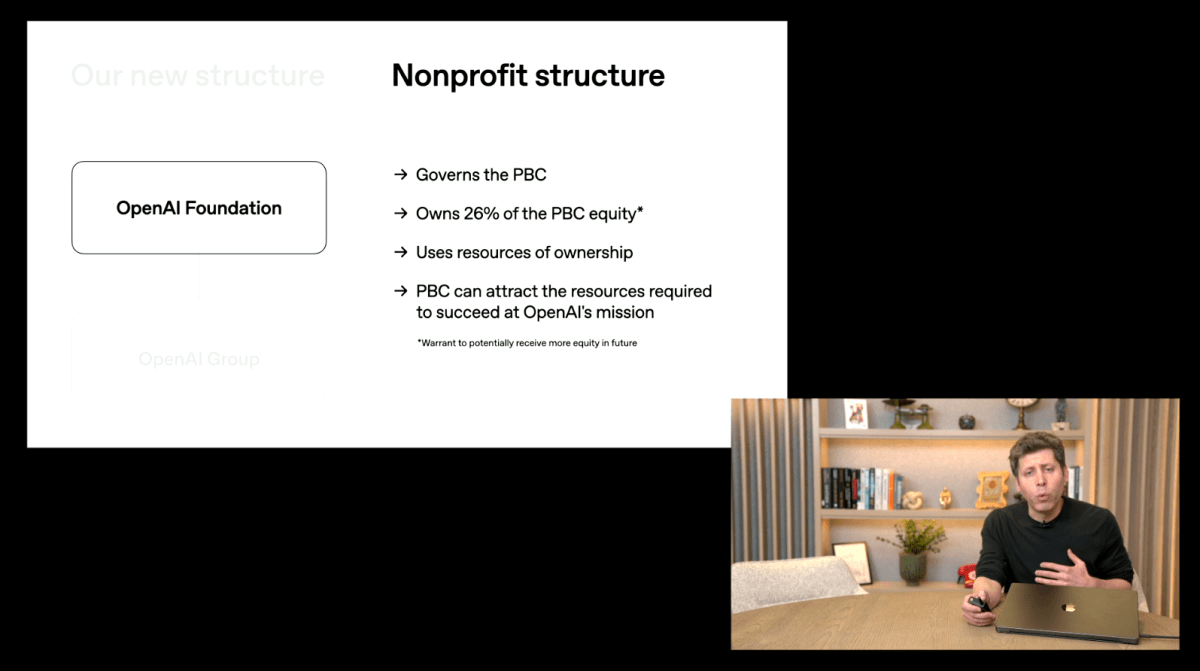
OpenAI’s transition to a public benefit corporation is a strategic move to support its aggressive timeline for AI development. This new structure allows the company to raise capital more freely while maintaining a commitment to responsible AI development. Under the reorganization, the non-profit OpenAI Foundation, which focuses on scientific advancement, will own 26% of the for-profit entity and oversee research direction and safety initiatives. The foundation has also committed $25 billion to using AI for curing diseases, underscoring OpenAI’s mission to use its technology for societal benefit.
Betting Big on Infrastructure
Altman highlighted the enormous infrastructure investments required to achieve OpenAI’s vision. The company has committed to building 30 gigawatts of infrastructure over the next few years—a $1.4 trillion financial obligation. This scale of investment underscores OpenAI’s confidence in the potential of AI to drive scientific progress and technological innovation across fields such as medicine, physics, and technology development.
A Future of Rapid Discovery
OpenAI’s roadmap paints a future where AI systems can make discoveries faster than human researchers, tackle complex problems beyond current human capabilities, and accelerate innovation across multiple industries. While the timeline is ambitious, the company’s focus on algorithmic innovation, computational scaling, and responsible development positions it as a leader in the race to unlock AI’s full potential.
As OpenAI pushes forward, the world will be watching to see if these predictions materialize. One thing is certain: the next decade could bring unprecedented advancements in AI, reshaping the way we approach scientific research and problem-solving forever.







No Comments